|
Play Therapy
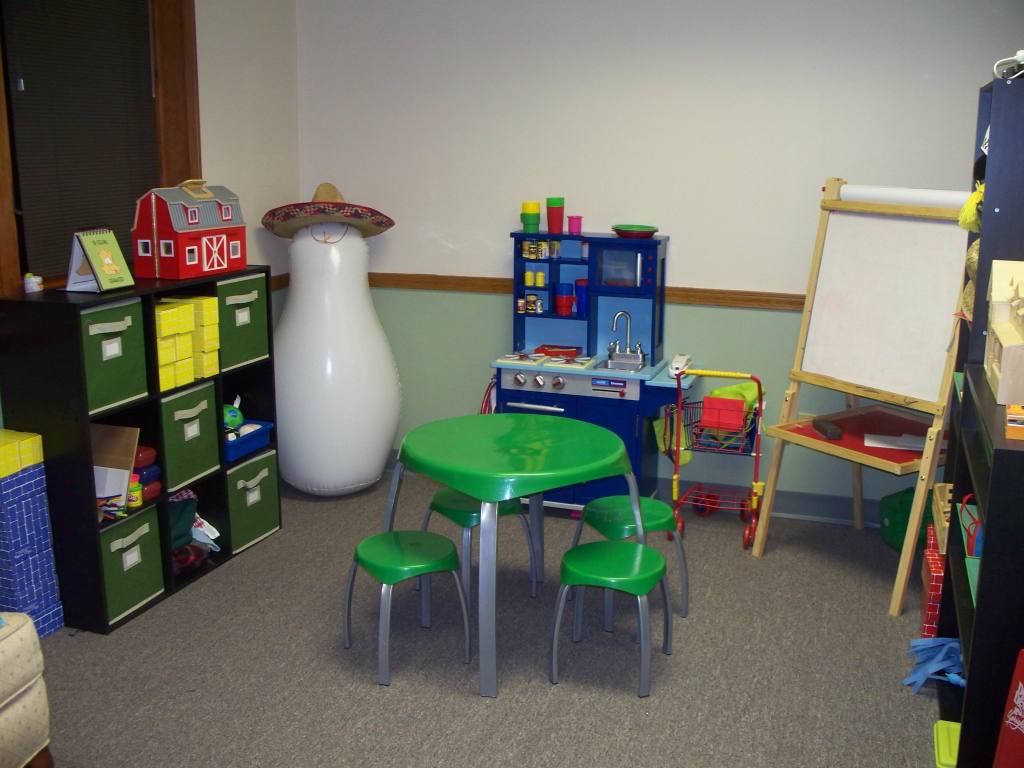
To the right, is an updated picture of our play therapy room.
At Step by Step Counseling, for families that are interested in play therapy, the first step is to contact our office for a parent intake. Here, during the parent intake, the guardian (parents, foster parents, guardians, caseworkers) comes in for an intake session without the child present. During this intake, the therapist will obtain a health and social history, as well as develop a treatment plan for the child with the guardian input. The treatment plan includes goals to work on, as well as the frequency of appointments.
During treatment, it's vital for the children to have consistent appointments, therefore your therapist will schedule your child's appointments at the same times.
Why play therapy?
Founder of the Center for Play Therapy at North Texas University, Dr. Gary Landreth, said “Fish swim, birds fly, children play.”
As adults, we communicate verbally through our language, in particular our words. Unfortunately, children have difficulty expressing themselves in the same way that adults do. Therefore, when working with children (or those who struggle to communicate verbally) typical "talk therapy" is not effective. By providing toys to children, a therapist gives them the tools they need to express their thoughts and feelings and ultimately work through the issues that are causing them difficulty.
The purpose of using play therapy is to empower and strengthen the child. Play is the language of children, therefore play therapy is typically used when counseling children to provide them an outlet to express their feelings and experiences. Children are provided a safe environment to work through and "play out" his or her feelings or problems. By doing this, the child is expressing (directly or indirectly) what is going on and allows them to strive towards resolving their issues. Research shows that over time, presenting behaviors (aggression, withdrawal ,etc) can be decreased when attending play therapy. If the child (or adult) seems to be acting out or struggling with their life circumstances, play therapy might be helpful for them.
If you have any questions about play therapy, or would like to set up an initial parent appointment please feel free to either call the office 636-255-0002 and leave a voice mail or email our staff at info@stepbystepcounselingllc.com. Our office has a Registered Play Therapist - Supervisor who would love to answer any questions that you might have about play therapy.
Some of Jennie's favorite quotes in regards to play therapy:
"Play is our brain's favorite way of learning." Diane Ackerman - Contemporary American author
"You can discover more about a person in an hour of play than in a year of conversation" Plato - 427–347 BC
“The child must know that he is a miracle, that since the beginning of the world there hasn't been, and until the end of the world there will not be, another child like him.” - Pablo Casals
Are you a School Counselor or a Mental Health professional? Jennie, our Registered Play Therapist - Supervisor, offers consultation and supervision services. Jennie can cater to the specific needs, whether it's for non-directive (or directive) Play therapy, Sand tray therapy or Filial therapy (parent-child relationship therapy). If you are a school counselor looking to add a play room or even adjust your current space to accommodating play therapy in your school space, Jennie, offers consulting services in choosing appropriate toys and setting up play therapy rooms/traveling play therapy kits. Mental Health Professionals
If you are a mental health professional in the field who works with children, Jennie,offers you an opportunity to consult or obtain supervision about specific cases or diagnosis.
From Association for Play Therapy: (Click on link above for more details) Play therapy helps children:
- Become more responsible for behaviors and develop more successful strategies.
- Develop new and creative solutions to problems.
- Develop respect and acceptance of self and others.
- Learn to experience and express emotion.
- Cultivate empathy and respect for thoughts and feelings of others.
- Learn new social skills and relational skills with family.
- Develop self-efficacy and thus a better assuredness about their abilities.
Some more quotes on play!
"Play is the highest form of research" Albert Einstein
"Play is our brain's favorite way of learning." Dianne Ackerman
"Letting Children go out and play is one of the best things that parents can do for their health." Professor Roger Mackett
|
 |
|
|
|
|
|